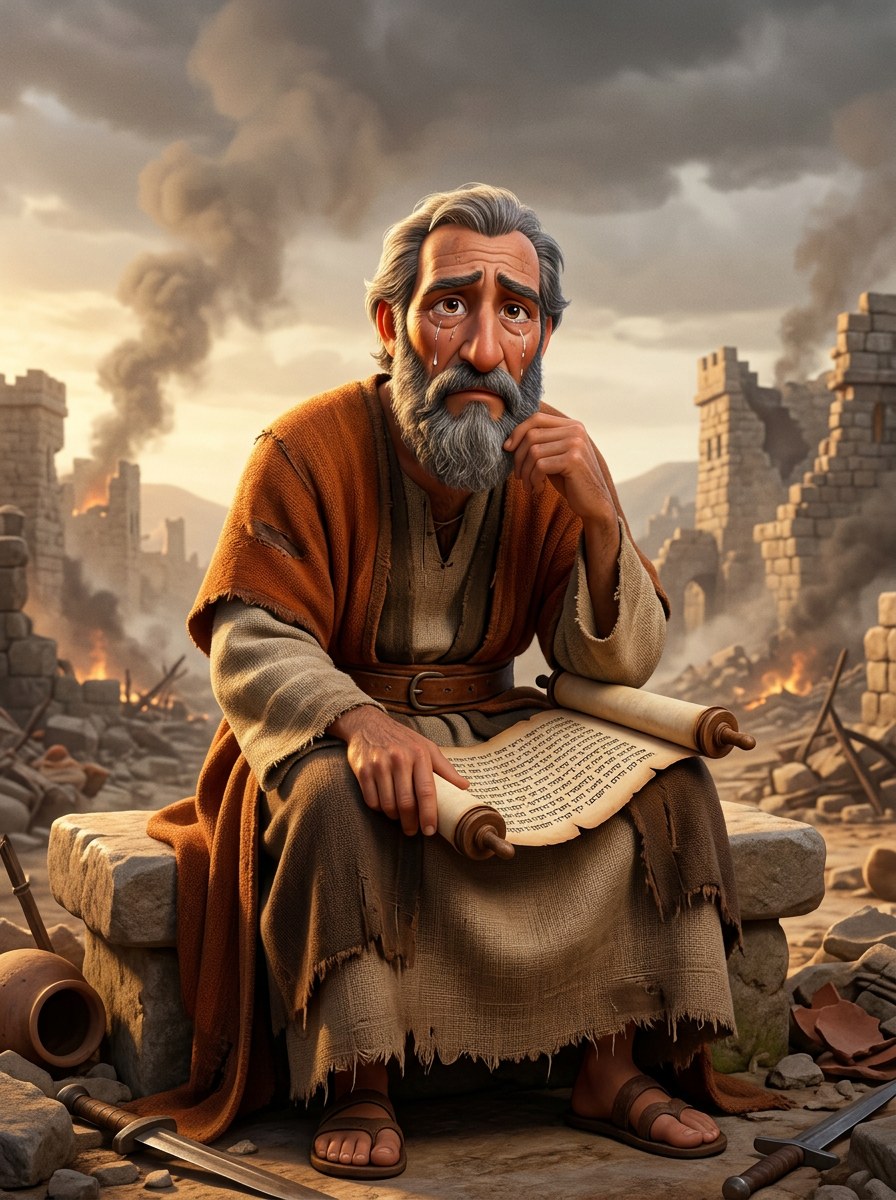
Jeremiah
The Weeping Prophet
7th–6th century BC
Called from his youth to prophesy the fall of Jerusalem, he wept over the people and the city.
“His mercies are new every morning; great is your faithfulness.” — Lamentations 3:22-23Talk with Jeremiah
The story of Jeremiah
Jeremiah is often called the weeping prophet because of the deep sadness he felt for his nation. Called to be a prophet while he was still very young, he was tasked with the difficult job of announcing the impending judgment of Jerusalem and the destruction of the Temple by the Babylonians. He consistently pleaded with the people to turn back to God, but his words were met with rejection, imprisonment, and hostility.
His life was a difficult struggle, yet he remained committed to the message God gave him. In his prophecies, he looked beyond the coming destruction to a time when God would restore His people and establish a new covenant—one written not on stone tablets, but on the hearts of the people. This vision of internal, personal transformation is one of the most powerful themes in the prophetic tradition.
Even after Jerusalem fell, Jeremiah remained with the remnant of the people in the land, eventually being forced to travel to Egypt. His life is a witness to the endurance required to hold to the truth when it is unpopular. He demonstrated that true loyalty to God involves speaking hard truths, trusting in God's promises even when current circumstances seem to indicate the opposite.
Key passages
Jeremiah 1:4–19
God calls Jeremiah to be a prophet to the nations.
Jeremiah 20:1–18
Jeremiah suffers for his message and laments his calling.
Jeremiah 31:31–34
God promises a new covenant with His people.
Jeremiah 36:1–32
Jeremiah dictates his prophecies to his scribe, Baruch.
Key books
- Jeremiah
- Lamentations
Questions you can ask
- “Why are you called the weeping prophet?”
- “Tell me about the new covenant”
- “What was the cistern like?”
Common questions
Why is he called the weeping prophet?
Because he deeply mourned for the coming destruction of his nation and suffered great rejection while trying to warn his people to repent.
What is the New Covenant mentioned in Jeremiah?
It is a promise of a new relationship with God where His law would be internalized in the hearts of His people, rather than being an external set of rules.
Did Jeremiah see the destruction of Jerusalem?
Yes, he witnessed the fall of the city and the exile of the people to Babylon, and he remained in the land afterwards.